Showing posts with label Vet. Show all posts

Tuesday, August 23, 2016

Microchip Pay if Forward!

Pay it Forward Chip Donation at White House Animal Hospital is in full swing! Wellness Rewards members that already have their pets microchipped are donating their free microchip! Nominate a pet to be the recipient of the microchip in the comments below the posts on our Facebook page https://www.facebook.com/pethospital, the comment with the most likes 48 hours from the time of the post will receive a free microchip!

Pay if Forward came out the +White House Animal Hospital August Microchip promotion!  FREE Microchip for the Month of August ($50 Value) at White House Animal Hospital with a new or renewed Pet Wellness Rewards Membership (http://www.whitehousevet.com/membershiprewards.html) or $10 with any exam for Non-Pet Wellenss Rewards Members. For More Information and scheduleing please visit http://www.whitehousevet.com/contactus.html and to see how microchips can save your pets life!  Wellness rewards members that already have their pets microchipped have opted to donate their microchip!


For more information please visit our Facebook Page at https://www.facebook.com/pethospital

Kristi May, MS, CVPM, LVMT, AHT, BS, ABCDT 
White House Animal Hospital 615-672-0357
Like us on Facebook at https://www.facebook.com/pethospital/
Follow us on Twitter at https://twitter.com/WHPetVet
Follow us on Pintrest at https://www.pinterest.com/WHPETVET/


Thursday, June 9, 2016

Heat Stroke in Pets a Medical Emergency!


When an animal is in a situation where it becomes overheated it is vital that it receive immediate medical intervention. 

Signs of Heat Stroke in Pets

  • Breathing difficulties as shown through:
    • Rapid breathing that appears frantic, noisy
    • Heavy panting
  • Tongue and mucous membranes will appear bright red
  • Saliva is thick and tenacious
  • Animal will often vomit
  • Taking a rectal temperature may confirm the diagnosis of heat stroke:
    • Normal temperature <102.5°
When left untreated, further heat stroke symptoms may show in ways such as:
  • Animal will appear unsteady and will stagger
  • Bloody diarrhea may occur
  • Lips and mucous membranes will change from bright red to pale blue or gray
  • Animal will:
    • Collapse
    • Have seizures
    • Fall into a coma
    • Die

Treatment for Heat Stroke in Animals

Pets suffering from heat stroke require immediate care. The longer an animal goes without treatment, the greater the chances are for the animal to suffer irreversible damage. Treating the animal requires:
  • Cooling its body down towards a normal temperature:
    • Move the animal out from the source of the heat
  • Using a rectal thermometer, begin monitoring the animal’s temperature every 10 minutes
  • In more severe cases, the following procedures may be taken:
    • Begin rapidly cooling the animal through methods such as:
      • Wetting the animal down with a hose
      • Immersing animal up to its neck in a tub of cool water, not ice water, for about 2 minutes
      • Placing wet animal in front of an electric fan
      • Applying cool packs or wet, cold towels to the armpits, groin, and on head
      • Wiping the paws and pads with cool water
    • Continue monitoring the rectal temperature until the temperature has lowered:
    • For both dogs and cats: temperature under 103° F
  • Once the animal’s temperature has been lowered, it is important to stop the cooling process and dry the animal off
    • Continuing with the cooling process after the temperature has been lowered may produce hypothermia and shock
Immediately bring pets in to see the veterinarian following an episode of heat stroke. Animals can experience delayed and secondary complications that occur within hours or up to days later, for example:
  • Kidney failure
  • Cardiac arrhythmias
  • Seizures
  • Laryngeal edema
  • Spontaneous bleeding
If you suspect your pet may have suffered a heat stroke, take immediate steps to reduce the body temperature and call White House Animal Hospital for help.  Call 615-672-0357 to get your pet in immediately

Kristi May, MS, CVPM, LVMT, AHT, BS, ABCDT 
White House Animal Hospital 615-672-0357
Like us on Facebook at https://www.facebook.com/pethospital/
Follow us on Twitter at https://twitter.com/WHPetVet
Follow us on Pintrest at https://www.pinterest.com/WHPETVET/

Sources:

Dog Owner’s Home Veterinary Handbook, 4th ed., D.M. Eldredge, L.D. Carlson, D.G. Carlson, J.M. Giffin
Cat Owner’s Home Veterinary Handbook, 3rd ed., D.M. Eldredge, D.G. Carlson, L.D. Carlson, J.M. Giffin

Tuesday, May 31, 2016

Start summer off right


Schedule your pet’s annual checkup todayto be sure your pet is healthy!


It’s summer! Time for BBQs, long hikes and refreshing water play! You and your pet enjoy this time of year. It’s filled with activity, fun and food!

There are a few things we have to talk about. First, is your pet eating the right food for their lifestyle? Meeting your pet’s nutritional needs is vital to their health and happiness. So before you take your big hike with Fido or start your movie marathon on the couch with Fluffy, bring in your furry friend for their annual exam.

Second, if your pet is just 10% over their ideal body weight (that may mean 1 lb. for a 10 lb. cat), they are at risk for developing serious medical conditions. Who wants that for their buddy? No way, you say! Come in for a checkup and a pit stop at the scale!

Third, most “people” food is not good for pets, especially from the grill! For example, feeding your pet chicken bones can cause tooth fractures and tear up their digestive tract during digestion.

Fourth, come in today to ensure your pets vaccinations and monthly preventives (Heartworm, Flea, and Tick) are up to date before heading out to the beach, lake, or park.  Let us know your vacation destination to ensure proper protection from disease!

Make an online appointment for your pet’s annual checkup today – we’ll give them a thorough physical exam from nose to tail! And we’ll talk about what they’re eating and if we have to make any changes.


Who loves your pet besides you? White House Animal Hospital of Course! Book your pet’s yearly exam today online or call 615-672-0357 Today so we can keep your pet healthy and happy this summer!

Monday, April 11, 2016

Q: Is your pet at risk for any of the following:


Q: Is your pet at risk for any of the following:

A) Fleas
B) Ticks
C) Worms
D) All of the above

A: D) All of the above (and they ALL can be tough to spot!)

Schedule your pet’s annual checkup today at http://www.whitehousevet.com/contactus.html to be sure your pet is healthy and enter your name in the drawing for a Free Supply of Vectra 3D!  Get one entry for every multi-pack of Vectra 3D purchase. 

Is your dog very tired? Is your cat eating less than usual? These seemingly minor changes may mean your pet has a flea allergy, an internal parasite infection, or a tick-related disease.

Let’s talk about fleas first. The majority of pets don’t have fleas—but many have been bitten because fleas are everywhere! Yes, fleas live outdoors but they can live indoors too – even in really clean homes – year-round in any climate. Fleas will gladly hitch a ride on your pet into your house. And all it takes is one flea bite (specifically the fleas saliva), to set off a full blown skin allergy. Pets may scratch their sides, neck or even lick their paws until they’re red and painful. What pet wants to move around or eat when feeling this miserable?

Internal parasites (such as worms) can infect your pet in a number of ways. Sometimes, it’s hard to know if your pet has them. But left untreated, worms can be dangerous to your pet’s internal organs. They can even cause your pet to lose blood.

Ticks are tricky. Even when you check your pet for ticks they can be tough to find because they’re small and hide well in dark fur. But it’s crucial to find ticks and remove them quickly. Why? Some ticks carry bacteria that cause disease (such as Lyme disease, but there are many others). And all you need is one undetected tick bite for your pet to become infected. They can become sick and develop kidney problems. At times, these diseases can be fatal.

Ugh! Is there any good news?

Yes!

We’re experts when it comes to flea allergies, tick and internal parasite checks at White House Animal Hospital. Even if your pet is on regular monthly preventive, it is still important for us to make sure your pet is healthy.  This month you have a chance to win a Free Years Supply of Vectra 3D with every multi-pack purchase of Vectra. Drawing May 1st and June 1st 2016!  

Make an appointment for your pet’s annual checkup today online at http://www.whitehousevet.com/contactus.html– we’ll give them a thorough physical exam from nose to tail. Let’s also confirm the prevention you’re using is right for your pet!

Kristi May, MS, CVPM, LVMT, AHT, BS, ABCDT 
White House Animal Hospital 615-672-0357
Like us on Facebook at https://www.facebook.com/pethospital/
Follow us on Twitter at https://twitter.com/WHPetVet
Follow us on Pintrest at https://www.pinterest.com/WHPETVET/

Tuesday, March 1, 2016

It is Almost Spring!

Time to check for heartworm disease! Schedule your pet’s yearly checkup today!


Prevent Heartworms

It’s March—springtime is around the corner! Worms in your garden…and worms in your pet? Eeew! Hold on, let’s explain…

The worms you find in your garden mulch are not the same worms that cause heartworm disease in pets. Mosquitoes carry heartworms. And all it takes is one mosquito to bite your pet to become infected.

Here’s the good news about heartworm disease. It’s an illness that can be easy and affordable to prevent. The bad news is, if you don’t prevent it the right way, your pet is at high risk of getting sick. Heartworm disease is dangerous to your pet and some signs of the illness are tough to spot. Your pet may be acting fine, but they may have so many heartworms inside their body that it can become life threatening.

You may be thinking, “my pet stays indoors, so there’s no need for heartworm prevention.” But, heartworms are carried by mosquitoes, which get into everyone’s homes! One mosquito bite is all that’s needed to spread the disease to your furry friend.

Schedule your pet’s yearly checkup with us. We’ll do a thorough exam, including a simple heartworm test, to make sure your pet is at his/her optimum health. And we’ll talk about the best way to prevent heartworm disease, so your pet stays healthy, happy and safe!


Make an appointment for your pet’s annual exam online today at http://www.whitehousevet.com/contactus.html


Kristi May, MS, CVPM, LVMT, AHT, BS, ABCDT 
White House Animal Hospital 615-672-0357
Like us on Facebook at https://www.facebook.com/pethospital/
Follow us on Twitter at https://twitter.com/WHPetVet
Follow us on Pintrest at https://www.pinterest.com/WHPETVET/


Thursday, February 18, 2016

Low Stress Vet Visits with Pheromones at White House Animal Hospital!


Low Stress is better not only for your pet but also for you!  Have you ever put off taking your pet for their annual wellness?  Don't put off your pets health.  White House Animal Hospital uses multiple low stress methods to help you and your pet have a better experience at White House Animal Hospital as well as receive well rounded care for not only the physical needs!


Stress 

Many situations can be perceived as stressful by dogs, such as loud noises (fireworks, thunderstorms, household appliances), going to the vet, traveling by car, home alone, kenneling/boarding, and changes in the home environment or the composition of the family.  Even small changes in your home and your daily routine can upset your dog and increase stress.

Stress can lead to unhappy behaviors such as hiding, excessive barking and whimpering, soiling in the home, and destroying household items.


Pheromones

White House Animal Hospital uses Adaptil and Feliway Pheromones in our lobby to help your pets relax before coming into the exam room.  The Veterinarians and staff treat their lab coats and scrub tops with pheromones as well as towels and kennels are treated in our hospital recovery to ensure your pets comfort from the time they walk in the door to the time they leave. 


Adaptil


The comforting pheromone in Adaptil has been clinically proven to help increase focus during training in puppies and adult dogs.  Additionally for dogs in stressful situations, Adaptil helps reduce the signs of stress which are usually inappropriate behaviors.
Adaptil is a synthetic pheromone that mimics the pheromone mother dogs emit after giving birth to help their puppies feel calm and secure.  Dogs of all ages recognize this pheromone throughout life.  
White House Animal Hospital has a variety of Adaptil products including diffusers, travel spray and collars to offer help in many situations, both indoors and outdoors, and for short-term and long-term use.

Feliway

When a cat feels comfortable in their environment, they rub their cheeks against objects leaving a facial pheromone.  Feliway is a synthetic copy of the feline facial pheromone used by cats to mark their territory as safe and secure.  
By mimicking the cat's natural facial pheromone, Feliway creates a state of familiarity and security in the cat's local environment.  As a result, Feliway can be used to help comfort and reassure cats while they cope with a challenging situation such as moving or traveling.  Feliway helps reduce or prevent unwanted behaviors caused by stress.
Feliway is available at White House Animal Hospital in the form form of a plug in diffuser that will diffuse an area of up to 700 square feet.

Multicat

Sometimes sharing a home can be difficult for cats. In fact, 60% of cat owners with more than 1 cat in the house report issues of tension between cats. If your cats aren’t getting along, use Feliway MultiCat.
Feliway MultiCat can help all cats living under one roof feel more safe and secure with their surroundings and ease animosity. It’s a copy of the feline appeasing pheromone mother cats produce during lactation. Cats of all ages sense this pheromone and it provides a calming effect that cats can recognize throughout life.
Multicat is available at White House Animal Hospital in the form form of a plug in diffuser that will diffuse an area of up to 700 square feet.
Kristi May, MS, CVPM, LVMT, AHT, BS, ABCDT 
White House Animal Hospital 615-672-0357
https://www.facebook.com/pethospital/

Adaptil, Feliway, and Feliway Multicat are trademarks of CEVA.  Whtie House Animal Hospital uses and provides these products for our clients.  For more information about CEVA Products please visit http://www.makinghappierpets.com/


Tuesday, February 9, 2016

10 Reasons to have your pets Teeth Professionally Cleaned

10 Reasons to have your pets 

Teeth Professionally Cleaned 


February is National Pet Dental Health Month! White House Animal Hospital wants to provide you with the best possible care; and to do so, we start with the teeth.  Have you ever noticed that all pet exams start with your Veterinarian checking your pets teeth?  Here are the reasons why!

1. Healthy Teeth equals Healthy Breath!
2. Dental disease can cause Heart, Liver, and Kidney problems.
3. Retained baby teeth can cause problems with Adult Teeth and crowd your pets mouth causing permanent tooth loss! Did you know that full grown dogs have 42 teeth and full grown cats have 30 teeth? Before their adult teeth grow in, their baby teeth have to fall out the same as people.
4. Caring for your pet’s teeth and preventing tarter and bacteria buildup can prevent serious health issues later in life, saving you tons of money over the long term!
5. You need regular dental care and you brush your teeth everyday – your pets are no different! Your veterinarian and favorite WHAH Technician can help you learn to brush your dog's teeth and your cat's teeth.
6. Did you know that 4 out of 5 dogs over the age of 3 years have some sort of periodontal disease? It can be caused by the buildup of plaque, so it’s important to go in for regular dental checkups and cleanings. Did you know that the health of your pets depends on the health of their teeth and gums.  Schedule your pets FREE Dental Exam today!
7. Pets that don’t get dental care can painfully lose their teeth – this can be terribly painful and cause serious health and digestion problems.
8. Your dog and cat are very good at hiding pain – you might never know that your pet has a serious dental problem until it’s very advanced. This is yet another reason it’s important to take your pet in for regular dental checkups and regular professional teeth cleanings.  Schedule your pets routine dental in the month of February 2016 and save up to 20% of the cost.
9. Teeth wear out! Your pets are tough on their teeth. Learn the symptoms to keep your pet from experiencing the pain of severely worn teeth:  Lack of appetite, refusing hard treats and chews, pawing at the mouth, and excessive drooling.  If your pet is experiencing any of these symptoms schedule an exam with Dr. Link, Dr, Gilbreath, or Dr. McRee to stop the pain today!
10. Learn more about the importance of dental care by visiting our Dental Month Facebook Event and our Blog
Call White House Animal Hospital today at 615-672-0357 or schedule online!
Kristi May, MS, CVPM, LVMT, AHT, BS, ABCDT 
White House Animal Hospital 615-672-0357
https://www.facebook.com/pethospital/ 

Friday, February 5, 2016

Dental disease is the most common disease in dogs and cats.

Dental disease is the most common disease in dogs and cats.


Does your pet have it?

It’s time to schedule their yearly checkup today and find out.


It’s that time of year again. Love, hugs and chocolate are on everyone’s mind. For your pet, the first two come out way on top! (Chocolate is a no-no, but you already knew that!)

Dental disease is the most common disease in dogs and cats, affecting 78% of dogs and 68% of cats over the age of three. Although most dogs and cats will develop some sort of dental disease, small dog breeds, such as Cavalier King Charles Spaniels, Dachshunds and Toy Poodles, are more prone to developing periodontal disease than larger breeds.

If your pet has bad breath, it may mean there is a problem with their teeth and gums. This can also contribute to more severe medical conditions. If dental issues are left untreated, you may put your pet at risk for problems in their mouth (periodontitis) or with internal organs (heart disease). The challenge most pet owners face is that even if their pet’s breath smells fine, some dental issues are hard to spot.

Early preventive measures, such as at-home care and in-clinic teeth cleanings will help to reduce the frequency and severity of dental disease later in life. At our hospital, we will perform a comprehensive examination of your pet’s teeth and gums (Free Dental Examination for February 2016). Just like when you visit your dentist, we use special tools to remove tartar from below the gum line and smooth the surface of each tooth to prevent tartar buildup.  Schedule your pets professional teeth cleaning in the month of February and Wellness Rewards Members can save up to 20% the cost!

Keeping your pet healthy from toe to tooth shows the world how much you love them. The best way to keep your pet in tiptop shape is to schedule your pet’s yearly checkup with us.  Schedule online today! We’re committed to your pet’s well being every step of the way. (Because we love them too!)


Happy Valentine’s Day!

Kristi May, MS, CVPM, LVMT, AHT, BS, ABCDT 
White House Animal Hospital 615-672-0357
https://www.facebook.com/pethospital/

Monday, February 1, 2016

Why does my dog’s breath smell?

Why does my dog's breath smell?

February Dental Month

            Causes of Bad Breath

Periodontal disease and stomach problems are the two most common reasons for pet halitosis. Canned pet food and à la carte garbage dining can contribute to stinky breath, but if your pet's breath is regularly repulsive, check their teeth. "Periodontal disease is the top health problem vets see, yet few owners ever look inside their pets' mouths," says Marty Becker, DVM, coauthor of Why Do Dogs Drink out of the Toilet?

Periodontal Disease

Studies show that after the age of 3 years, 80 percent of dogs and cats will have signs of periodontal disease.  Classic signs of periodontal disease include red, bleeding gums and brown buildup on teeth, changing in eating behaviors, refusing hard kibble and treats, pawing at the mouth, rubbing face and muzzle on the carpet, and missing teeth.  Avoiding periodontal disease is essential: Animals with periodontal disease experience pain and bacterial infection that can contribute to heart, liver and kidney damage. "Good oral health is the furry fountain of youth," Dr. Becker says. It can help your pet live 15 percent longer.

Dental Exam

Get your pet's mouth checked twice a year.  This February bring your pet to White House Animal Hospital for a Free Dental Exam!  Schedule your pet's free exam online today by clicking here and get a Free Pet Finger Tooth Brush.  If your pet is diagnosed with periodontal disease, book a professional teeth cleaning in February and save up to 20% (including the extraction of loose and infected teeth if necessary). 

Preventing Bad Breath

Help prevent tartar and plaque from building up after your pets professional teeth cleaning by brushing your pet's teeth at least once a week (Get your Free Pet Finger Brush with every Free Dental Exam or Professional Teeth Cleaning) or wiping Clenza dent Gel on your pets teeth.  White House Animal hospital also carries Royal Canine Dental Diets for cats and dogs, as well as a variety of dental chews.  Dental care is an important part of your pet's health care, as teeth can not be replaced.  

Ruling out Digestive Problems

What if your pet's mouth looks healthy? Digestive problems may be the cause of his stinky breath. "If there's unhealthy bacteria in the intestinal tract, it can persist and worsen, causing bad breath," explains Dr. Becker.  Get your pet examined today to rid your pet of bath breath!  Schedule online at http://www.whitehousevet.com/contactus.html or call our office at 615-672-0357!

Kristi May, MS, CVPM, LVT, AHT, BS, ABCDT 
White House Animal Hospital 615-672-0357
Like us on Facebook at https://www.facebook.com/pethospital/
Follow us on Twitter at https://twitter.com/WHPetVet
Follow us on Pintrest at https://www.pinterest.com/WHPETVET/


Wednesday, January 13, 2016

Leave no stone unturned: Schedule your pet’s yearly checkup to ensure their kidney and urinary health

Leave no stone un-turned:
Schedule your pet’s yearly checkup to
ensure their kidney and urinary health


Did you know 75% of your pet’s kidney function is gone before you see signs of serious illness? That means your pet may have kidney disease and you may not even know it.

This month we want to focus on your pet’s kidney and urinary tract health because this is an area of veterinary medicine (and human medicine too) where preventive healthcare can make a big difference! A routine blood and urine test can clue us into the status of your pet’s kidney and urinary system. It’s that simple.

When we talk about chronic kidney disease, it’s a very common disorder in cats, especially those that are older than age 5. Renal (kidney) insufficiency or renal failure occurs when the kidneys are no longer able to do their appointed job--to remove waste products from the blood.

Renal failure is not the same as not being able to produce urine. In fact, most cats with renal failure make lots of urine in an attempt to remove the waste products that collect in the blood. The kidneys are failing but the cat makes a huge volume of urine... this can be confusing to pet owners!

Let’s switch gears and talk about urinary stones. Dogs or cats with very small stones in the urinary system do not usually have any signs. They look and act the same as usual. However, if these stones become larger, and are not detected and monitored, they can move into other areas of the urinary system that may cause obstruction. Obstruction is an emergency that puts your pet’s health at serious risk.

The best way to keep your pet’s kidney and urinary tract health in tiptop shape is through preventive healthcare. Schedule your pet’s yearly checkup today so we can examine your pet from nose to tail, run any tests if needed and discuss all the concerns you may have.

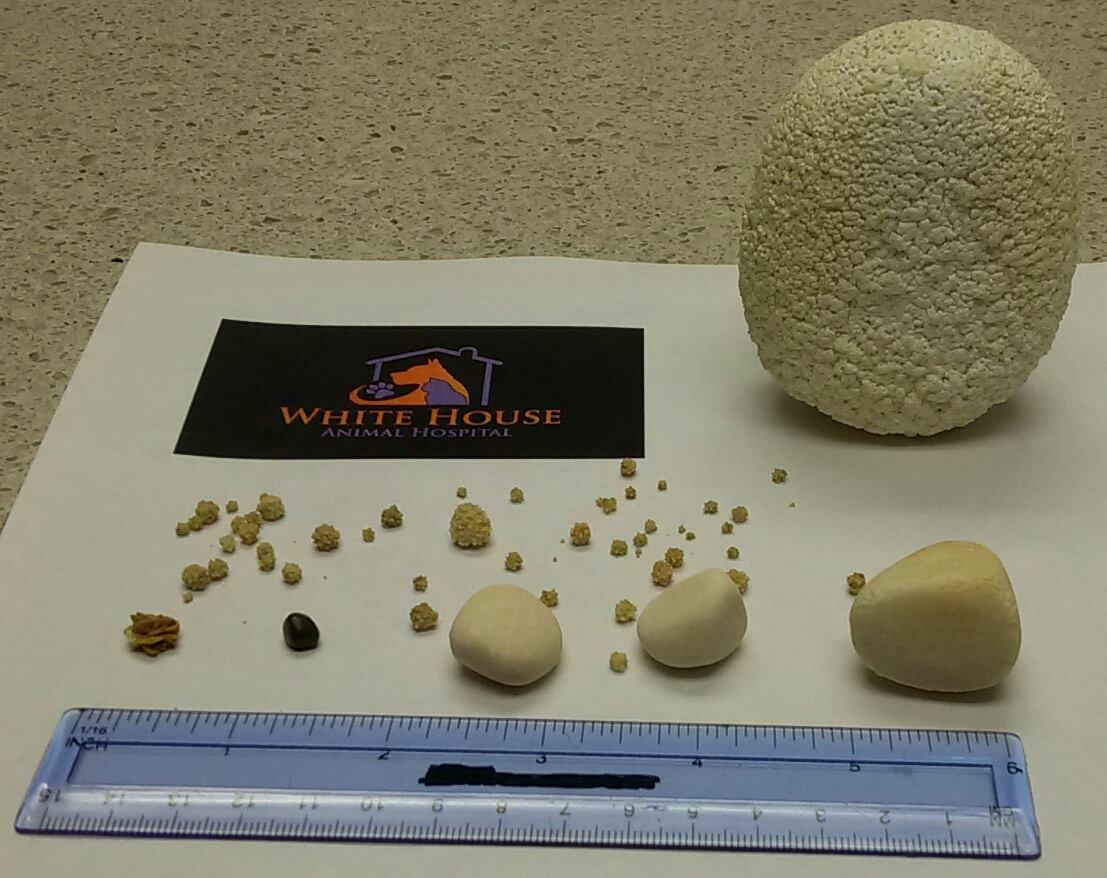
Pictured are several types of bladder stones that have been removed from pets at White House Animal Hospital.  Have your pet checked today!  Did you know that many of theses stones could have been prevented by diet?  Ask your favorite Veterinarian about your pets diet today!


We care about your pet visit our Website and Schedule your pets appointment online today at http://www.whitehousevet.com/contactus.html

We promise, we will leave no stone unturned.


Kristi May, MS, CVPM, LVMT, AHT, BS, ABCDT 
White House Animal Hospital 615-672-0357
Like us on Facebook at https://www.facebook.com/pethospital/
Follow us on Twitter at https://twitter.com/WHPetVet
Follow us on Pintrest at https://www.pinterest.com/WHPETVET/

Monday, December 7, 2015

Pack your bags....But not the holiday pounds!


Pack your bags.
Pack your car.
Pack your sleigh.
But don’t let your pet pack on the holiday pounds.

Schedule your pet’s yearly checkup today.


Holiday season is upon us — a busy time of year for festivities, family and of course, lots of eating! Did you know that if a ten-pound cat ate just one ounce of cheddar cheese from your hors d’oeuvres, it would be the same as if a person ate three and a half hamburgers or four chocolate bars? Gaining those “holiday pounds” is not just a problem for humans, but also for our four-legged friends.

Research shows that pets are more likely to gain unwanted pounds during this holiday period than any other time of year. What pet can resist a potato chip, onion dip or chocolate? (Wait, you know better than to feed them that!)

Obesity is the leading medical problem in pets. When a pet is too chubby, not only may they have little energy to walk or play, but also studies have shown that pets who are overweight may have a shortened life span.

How can you tell if your pet is at the right weight?

It can be hard to know because for many pets, they don’t get a big round belly. Instead, the extra fat is well hidden inside your pet’s body, tucked between their vital organs. So let us check! Our veterinary practice team has a trained eye to best assess your pet’s weight. Bring your pet in for their yearly exam and we’ll take a look at their body condition and nutritional needs. If we determine your pet needs to lose a few pounds, don’t worry. We’ll come up with a plan that will keep you and your pet sailing through the holiday season.

Call us today to schedule your pet’s yearly checkup or book you appointment online http://www.whitehousevet.com/contactus.html. 

Happy holidays and remember, pack your suitcase. Pack a trunk. It’s even fine to pack a sleigh. But don’t let your pet pack on the pounds!


Kristi May, MS, CVPM, LVMT, AHT, BSA, ABCDT 
White House Animal Hospital 615-672-0357
https://www.facebook.com/pethospital/

Monday, November 9, 2015

Are you Overfeeding your Pet?

Pet Caloric Requirements and RER

Pets’ energy (Calorie) intake needs to maintain a healthy weight for their life stage and depends upon several factors. First, the energy to perform essential body functions like digestion, respiration, heart functions, brain functions, etc. (Resting Energy Requirements or RER), which can be calculated by multiplying the animal’s body weight in kilograms raised to the ¾ power by 70, for example, a 10kg (22lb) adult neutered dog of healthy weight needs RER = 70(10kg)3/4 ≈ 400 Calories/day. One also can use the charts below to estimate resting calorie needs.


Table 1. Known life stages and corresponding factors used to estimate daily energy needs for dogs.
Neutered adult
=1.6 x RER
Intact adult
=1.8 x RER
Inactive/obese prone
=1.2-1.4 x RER
Weight loss
=1.0 x RER for ideal weight
Weight gain
=1.2-1.8 x RER for ideal weight
Active, working dogs
=2.0-5.0 x RER
Puppy 0-4 months
=3.0 x RER
Puppy 4 months to adult
= 2.0 x RER
Source: http://vet.osu.edu/vmc/companion/our-services/nutrition-support-service/basic-calorie-calculator

Determining How Much Food to Feed

Richard H. Pitcairn, DVM, PhD, author of Dr. Pitcairn’s Complete Guide to Natural Health for Dogs and Cats, believes the most reliable approach is to feed what seems to be a reasonable amount and monitor his body weight.
“You should be able to feel your pet’s ribs easily as you slide your hand over his sides,” Pitcairn says. “If you can’t, he’s probably too heavy, so begin to feed a smaller quantity.”
If you’re using a commercial pet food, beware of the “feeding guidelines” on the bag or box. It lists different weights and the corresponding amount of food to feed your dog to maintain that weight, and should be used only as a rough guideline.
Many dogs are overweight because their families closely followed the directions on the label, which often indicates portion sizes that are too large. Dr. Link recommends that as a rule of thumb, unless the dog is over one hundred pounds, then do not feed more than 4 cups of food daily.
Starting at the low end of the suggested guidelines and then monitoring your dog for hunger and body condition is a good way to proceed.  If you are having difficulty finding the right diet or amount please contact White House Animal Hospital at http://www.whitehousevet.com/contactus.html

Treats Count as Calories

When feeding treats in a diet it is important to calculate them into the daily caloric intake, they are calories!  Most of us are guilty of sneaking a tasty table scrap to our pets during or after dinner. While there is not anything inherently wrong with giving your pet an occasional morsel left on your plate, there are some very good reasons to limit your handouts to treats made for dogs. Giving dogs a bit of leftover lean meat, non-buttered vegetables, and a little rice will not cause problems, but unfortunately, many people do not stop there.

Here are charts of common pet treats from Royal Canin to help you determine if you are over feeding with treats.


Overview of Pet Feeding

Choose a high-quality food and look at the recommendations on the label. Remember, these feeding recommendations are simply guidelines, not absolutes. There is often a wide range listed and there is little consistency in feeding guidelines between brands. You must consider the following, and adjust the food amount accordingly:
  • The actual calorie content of the food
  • Your pet's weight (and projected target weight if necessary). Ask your veterinarian if you're not sure about an ideal weight for your pet
  • Your pet's activity level
  • Other environmental variables (temperature)
  • Any additional calories from treats or table foods
  • Remember, most pets are overfed and under-exercised - so, if in doubt about how much to feed initially, feed a little less
After you have started feeding your pet an appropriate amount of food, weigh your pet at least once a month to determine if you (and your pet) are on the right track. If necessary, increase or decrease the amount of food slightly until the pet stays at his ideal weight. You can easily weigh your small dog or cat on your bathroom scale - simply weigh yourself while you hold your pet, then weigh yourself without your pet and subtract the difference. Larger dogs can usually be weighed at your veterinarian's office just stop on in and use our scale at White House Animal Hospital, no appointment necessary. Remember, most pets are overfed and under-exercised - so, if in doubt about how much to feed initially, feed a little less. 

Kristi May, MS, CVPM, LVT, AHT, BS, ABCDT 
White House Animal Hospital 615-672-0357
https://www.facebook.com/pethospital/